
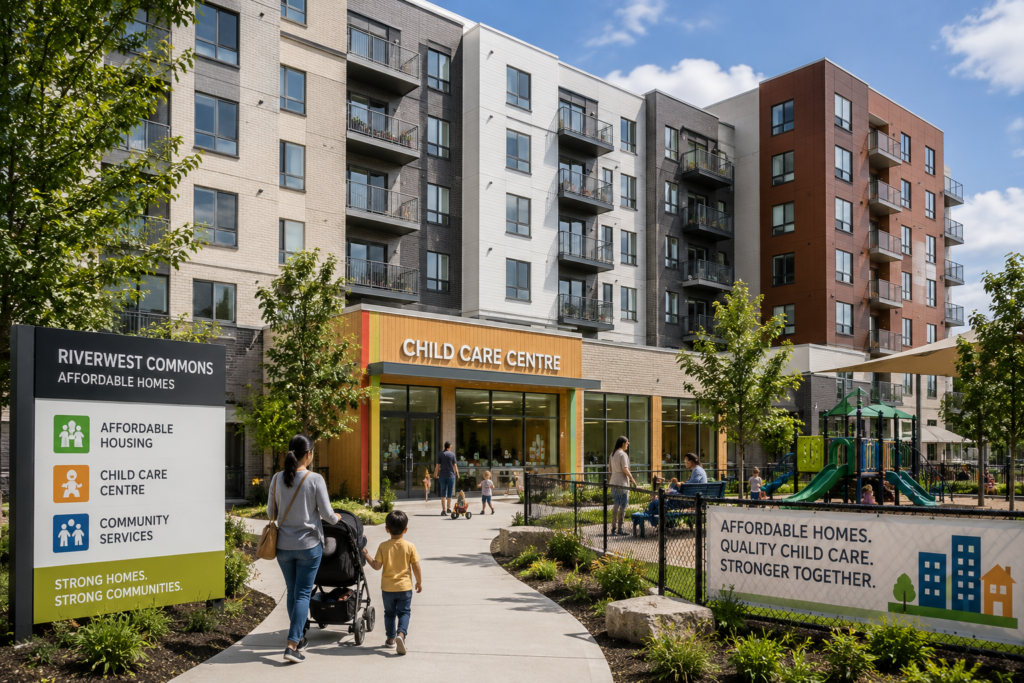

Canada continues to face two interconnected challenges: a shortage of affordable housing and a shortage of licensed child care. While governments often treat these issues separately, a recent report, Co-Locating Child Care and Housing in Canada by Dr. Carolyn Whitzman and Priya Perwani, argues that planning them together can create stronger communities and improve outcomes for families. The report suggests that integrating child care into affordable housing developments can reduce barriers to employment, improve access to services, and make better use of public investment.
Why does co-locating child care and housing matter?
Housing alone does not create a complete community. Families also need access to services that support everyday life, including child care, schools, health care, recreation, and public transit.
The report notes that Canada has approximately 4.4 million households in need of affordable housing, including 3 million households requiring deeply affordable homes. At the same time, many communities continue to experience significant shortages of licensed child care spaces. Single mothers are among those most affected because they often face both housing affordability challenges and difficulty accessing child care needed to participate in the workforce.
Locating child care where families live can provide several benefits:
- reduces travel time and simplifies daily routines;
- supports parents returning to work or education;
- reduces transportation costs and congestion;
- creates more complete neighbourhoods;
- improves access to child care in communities that currently have few or no licensed spaces.
Unlike workplace child care, neighbourhood-based child care continues to serve families even if parents change jobs, making it a more stable long-term solution.
If the benefits are so clear, why isn’t this happening more often?
According to the report, the challenge is not a lack of good ideas, but rather barriers related to funding, coordination, and planning. Several recurring issues continue to make co-located housing and child care developments difficult to deliver:
- Fragmented government coordination: Housing and child care are funded and managed by different levels of government and departments, making projects complex to coordinate.
- Funding uncertainty: Housing and child care often rely on separate funding streams with different timelines and requirements, delaying projects or preventing child care components from moving forward. For example, housing developers need commitments 4 years prior to construction. So far, child care commitments are only running up to a maximum of one year in advance. Thus, the timing mismatch means that opportunities are lost.
- Affordability challenges: Current definitions of affordable housing do not always reflect what low-income families can realistically afford.
- Planning and data gaps: Governments tend to measure the number of housing units and child care spaces created rather than whether families have access to both services where they live. The report recommends identifying and addressing both housing and child care “deserts.”
Ontario is already demonstrating what co-location can look like
Although challenges remain, Ontario has several projects showing how housing, child care, and community services can be integrated.
Project | Location | Status | Project Description |
Biindigen Well-Being Centre | Hamilton | Under development (2026–2028) | Will include 60 affordable housing units, an Indigenous-led child care and family services hub (number of spaces not yet announced), an Indigenous health centre, medicine gardens, a sacred fire circle, an Elders’ meeting room, youth hub, and gym, creating a culturally appropriate community hub. |
1388 Highland Rd. W. | Kitchener | Delayed | Will include 208 rental units, with one-third designated as affordable for 40 years, and an 88-space licensed child care centre operated by RisingOaks Early Learning (age groups not announced). The project has been delayed due to funding uncertainty and coordination challenges. |
Lawrence-Orton Community Centre and Child Care Facility | Toronto | Opened 2021 | Redevelopment of an existing Toronto Community Housing site featuring a 54-space licensed child care centre serving children from infancy to age five, dedicated outdoor play space, and five classrooms. |
Alexandra Park Revitalization | Toronto | Opened 2026 | Includes 103 homes (99 rent-geared-to-income replacement units and 4 new affordable rental units) and a 62-space City-operated child care centre serving children aged 0–4, along with community gardens and shared amenity space. |
CreateTO (770 Don Mills Road) | Toronto | Planned (2030) | Will include 1,254 housing units, including 836 affordable rental homes, two non-profit child care centres with 62 spaces each (124 spaces total) (age groups not announced), an elementary school, public park, and retail space. |
Haney Street & 709–725 King St. Mixed-Use Development | Port Colborne | Planned (2028–2029) | Will include 40–50 affordable rental apartments and a ground-floor licensed child care centre (number of spaces and age groups not yet announced). |
Queensway + Algie | Toronto | Proposed | Plans include 1,819 residential units, including 342 affordable rental homes, 700 m² of daycare space, community services, retail, and a public park. A child care operator, number of spaces, and age groups have not yet been announced. |
Generations Toronto | Toronto | Opened Spring 2026 | Includes 390 below-market affordable rental homes, a 60-space licensed child care centre serving children aged 18 months to 6 years, a long-term care home, primary health care clinic, and community programming. |
County of Simcoe Orillia Campus Development | Orillia | Opened Spring 2024 | Includes 130 affordable rental housing units (including 46 family-sized units), a 165-space licensed child care centre serving infants through school-age children, an EarlyON Child and Family Centre, and multiple community services. |
Recommendations for Moving Forward
The following recommendations are drawn directly from Co-Locating Child Care and Housing in Canada:
- provide long-term capital and operating funding for both affordable housing and child care;
- create dedicated funding for adding child care to housing retrofits and redevelopments;
- prioritize projects that integrate affordable housing with child care and other community services;
- use Build Canada Homes to create complete communities that include child care, schools, health services, libraries, and parks;
- require governments to identify housing and child care “deserts” and target investments accordingly;
- prioritize public land for non-market housing and public or non-profit child care;
- improve coordination between governments and departments responsible for housing and child care;
- remove planning and regulatory barriers that make mixed-use developments more difficult; and
- expand support for Indigenous-led housing and child care projects.